Support Coordination under the NDIS is rewarding work, but it’s also complex. With multiple providers involved, changing participant needs, and strict compliance requirements, it’s no surprise that many organisations are facing growing operational pressure just to keep everything running smoothly.
Working across a wide range of settings, the demands are consistent: keeping track of appointments, contacts, tasks, documentation, and ever-changing participant needs, all while staying compliant and responsive.
That’s no small task. Matching the right supports to participant goals, monitoring budgets, and maintaining accurate records requires speed, clarity, and structure. Without quick access to information and a clear overview of what’s happening at any given time, even the most experienced coordinators can feel stretched.
This is where NDIS Support Coordination Software becomes essential. Purpose-built NDIS Support Coordination Software is designed specifically to handle the unique challenges of disability support services. Unlike general-purpose management tools, it supports the realities of support coordination, from real-time information access and task tracking to compliance, communication, participant management, and budget oversight.
The Growing Complexity Of NDIS Management
The NDIS has grown into one of Australia’s most important support systems, but it has also become one of the most complex. With more than 700,000 participants currently supported (and projections showing this could exceed one million by 2034), the scheme has evolved into a highly regulated, market-driven environment that requires constant navigation, monitoring, and documentation.
While the NDIS is designed to deliver personalised support, the reality is that managing an NDIS plan comes with intense administrative demands. Plans require ongoing tracking, compliance checks, reporting, budget management, and coordination between multiple providers, family members, and support networks.
There is no doubt that support coordination is essential to help those with complex needs and their families navigate the NDIS.
This complexity is further driven by several major factors:
- Stricter regulation and compliance requirements mean every decision, provider engagement, and service delivery detail must be documented accurately. Coordinators and providers are expected to meet growing standards of accountability, which increases pressure and adds layers of red tape.
- Shifting definitions of what counts as “reasonable and necessary” support also creates uncertainty. What may have been approved in one plan period could be questioned or rejected in the next, forcing coordinators to constantly adapt and stay informed.
- Increasing participant expectations is another major driver. As the scheme grows, participants are more informed, more empowered, and more vocal about the outcomes they want, which is a positive shift, but also increases the need for responsive service coordination and fast decision-making.
- Funding pressures and tighter budgets mean there is less room for inefficiency. Coordinators must ensure funds are used strategically, avoid overspending, and track plan utilisation closely, while still meeting participant goals.
- And then there’s the reality of the market itself. Provider shortages, scheduling delays, and limited service availability often create major roadblocks. Support Coordinators are left to manage urgent gaps in care, last-minute cancellations, and the constant challenge of finding suitable providers who are available and aligned with the participant’s needs.
All of this contributes to one major issue: traditional admin methods no longer work.
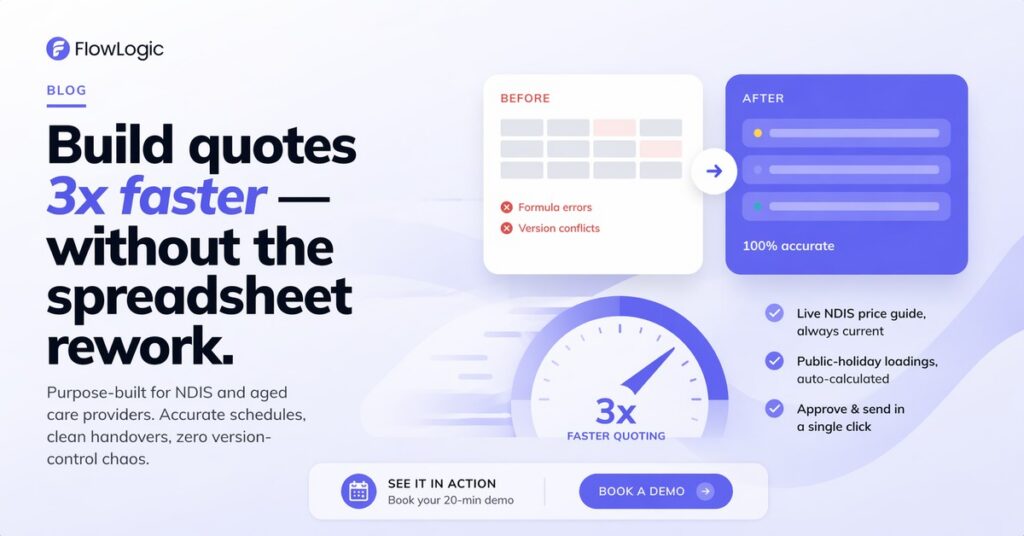
Spreadsheets, email trails, scattered notes, and manual task lists simply can’t keep up with the moving parts of modern NDIS coordination. When everything is tracked across multiple systems, information gets lost, deadlines are missed, and risks increase.
Why Manual Systems Are Putting Providers at Risk
Today, manual systems are inefficient and a genuine operational risk. While manual documentation works when caseloads were smaller and compliance requirements were lighter, they simply can’t keep up with the complexity of modern support coordination.
- Errors in invoices and claims are one of the most common issues. Manual data entry leads to mistakes like incorrect dates, duplicate claims, missing details, or pricing errors. These issues often result in rejected claims, delayed payments, disrupted cash flow, and additional admin work, all of which strain already tight resources.
- Missed plan milestones are another major risk. With claims required within strict timeframes and plan reassessments often delayed, missing a deadline can mean lost funding that can’t be recovered.
- Poor participant experience quickly follows. Billing issues, slow responses, and inconsistent communication reduce participant confidence and limit choice and control, undermining the very outcomes the NDIS is designed to deliver.
- Burnout and high staff turnover are also unavoidable consequences. Manual systems increase workload, mental fatigue, and stress for Support Coordinators already managing complex cases. Over time, this leads to exhaustion, disengagement, and higher turnover, putting further pressure on teams and service continuity.
What Is NDIS Software?

NDIS software is a specialised management system designed specifically for disability service providers operating under Australia’s National Disability Insurance Scheme. It brings together essential functions like participant management, compliance monitoring, rostering, billing, reporting, and plan tracking into one central platform.
Unlike multiple or generic CRM systems, NDIS software is built to handle the realities of NDIS service delivery. Traditional CRMs may be useful for basic contact management, but they typically lack the features providers rely on daily, such as NDIS pricing alignment, plan budget tracking, goal monitoring, and NDIA claiming support. This often leads to workarounds, duplicated admin, and a higher risk of errors.
It also plays a major role in simplifying workflow. It helps manage caseloads, track tasks and follow-ups, coordinate providers, schedule meetings, and keep participant information accessible and up to date. Instead of juggling spreadsheets, notes, and disconnected tools, coordinators can manage everything in one secure system.
6 Key Features Of Our NDIS Software
Not all NDIS software is created equal. The platforms that truly support modern support coordination share one thing in common: they’re built specifically for the complexity of disability services, not adapted from generic business tools.
At FlowLogic, we’ve developed an intelligent NDIS software solution designed to support the real-world demands of providers across Australia. From participant management and budget tracking to compliance, reporting, and workflow automation, our platform brings everything into one streamlined ecosystem
- Comprehensive Participant and Case Management
Strong NDIS software starts with participant management. FlowLogic centralises all participant information into detailed profiles that capture goals, preferences, progress notes, health records, and key documentation.
Key features include:
- Centralised participant profiles with goals, preferences, documents, and progress notes
- Specialised support coordination forms that simplify reporting and workflow management
- Customisable intake and assessment tools, including risk assessments, consent forms, and onboarding documentation
- Goal tracking and outcomes reporting to demonstrate participant progress and measurable results
- Health and medical record storage, keeping critical information accessible but protected
- Case note audit trails that ensure accountability and continuity of care
- Stakeholder communication tools for reporting and updates to families and support networks
This means coordinators can spend less time chasing information and more time supporting participants.
2. Financial Management and Real-Time Budget Tracking
Budget oversight is one of the most critical parts of support coordination, and one of the easiest areas to get wrong without the right tools.
Our software provides real-time visibility into participant funding, tracks utilisation across categories, and helps coordinators avoid overspending or missed opportunities. It also supports automated invoicing, bulk claiming, and price guide alignment to reduce claim errors and improve cash flow.
Essential financial features include:
- Live budget dashboards that show plan utilisation in real time
- Multi-funding stream tracking, ideal for participants with complex plans
- NDIS price guide alignment, ensuring billing stays accurate and compliant
- Invoicing and claiming workflows, reducing admin time
- Bulk claiming with built-in error detection, minimising rejected claims
- Split invoicing functionality for participants with shared payment responsibilities
- Accounting integrations with various platforms
3. Enterprise-Grade Compliance, Governance, and Audit Readiness
Compliance in the NDIS isn’t a checkbox exercise. It’s an ongoing operational responsibility that touches every part of your operations. FlowLogic is built to meet the compliance demands of providers at every scale, from growing independents to large multi-site enterprises, with governance tools that give leadership real visibility across operations.
Our platform builds compliance into daily workflows rather than treating it as an afterthought. Structured documentation, secure record storage, document expiry alerts, and reporting tools mean your team stays prepared at all times, not just during audits.
For leadership and executive teams, FlowLogic provides live compliance dashboards, governance reporting, and performance oversight tools that surface risk before it becomes a problem. Decision-makers get a clear, real-time picture of compliance status without needing to chase reports from individual teams.
Key compliance and governance features include:
- Live compliance dashboards for leadership and management oversight
- Structured documentation tools aligned with NDIS Quality and Safeguards Commission requirements
- Policy and procedure library management
- Internal audit scheduling with corrective action and follow-up tracking
- Mandatory training tracking with automated alerts for expiring certifications
- Secure document management with expiry and renewal alerts for mandatory certificates and policies
- Quality improvement planning tools
- Incident and feedback forms with structured workflows and full audit trails
- Role-based access controls so the right people see the right information at every level of the operation
4. Configurable Workflows That Suit Your Operational Needs
Every disability service provider operates differently. Your intake process, case management approach, service delivery model, and reporting requirements are unique to your operational needs, and your software should reflect that.
FlowLogic is built to be configured around your operational needs, not the other way around. Rather than forcing your team to adapt to a rigid, out-of-the-box solution, FlowLogic gives you the flexibility to shape the platform around your existing workflows, terminology, and processes.
Configuration capabilities include:
- Customisable forms, workflows, and templates across all core functions
- Configurable intake, assessment, and onboarding processes to match your service model
- Conditional workflow triggers that reflect your operation’s approval and escalation processes
- Multi-step approval flows for consistent governance across teams
- Automated reminders to keep tasks and compliance obligations on track
- Adaptable role and permission settings across teams, sites, and service types
- PRODA/PACE integration for streamlined invoicing and claims submission
- Scalable functionality suitable for growing providers through to large multi-site organisations
This means you get the efficiency of purpose-built NDIS software without sacrificing the operational processes.
5. Smart Rostering, Scheduling, and Staff Management
NDIS support coordination involves endless moving parts. Coordinators need to manage staff availability, participant needs, service frequency, and provider coordination, all while minimising gaps in support.
FlowLogic’s rostering and staff management tools are built for this complexity, helping providers schedule the right people at the right time while keeping workforce compliance firmly in check.
Key features include:
- Advanced scheduling tools for appointments, service delivery, and follow-ups
- Availability and preferences management for support workers
- Skill and qualification matching, ensuring participants receive appropriate support
- Award-based warning system to flag compliance risks in rostering decisions
- Bulk shift editing functionality for efficient schedule management
- Mandatory training tracking with automated alerts for expiring certifications
- Staff feedback forms and incident reporting with structured audit trails
- Improved visibility across caseloads, helping teams allocate resources more effectively
6. Security, Data Protection, and Australian Local Support
Because NDIS providers manage highly sensitive participant information, security must be a top priority. FlowLogic holds ISO 27001 certification and implements enterprise-grade protections, including encryption, two-factor authentication (2FA), role-based access controls, and data residency controls, ensuring participant data is protected and stored responsibly.
When you need support, you’re speaking to people who understand the Australian NDIS environment. Our local support team has direct experience in the disability sector, which means faster resolution times and advice grounded in the realities of running an Australian NDIS business.
Security and support features include:
- ISO 27001 certified – the internationally recognised standard for information security management
- Two-factor authentication (2FA) for secure platform access
- Role-based access controls ensure the right people have access to the right information
- Data residency controls to support your compliance obligations
- Regular security audits and ongoing compliance monitoring
- Australian-based support team with hands-on NDIS sector experience
- Regular platform updates aligned with NDIA policy and price guide changes
- Onboarding and ongoing support from people who understand the Australian disability landscape
The Benefits of NDIS Management Software

NDIS software isn’t just about making admin easier, it’s about delivering better support outcomes in a system that’s becoming more complex every year.
Better Participant Outcomes
- Faster Service Connections = Faster Support: NDIS software helps coordinators connect participants with the right supports faster by streamlining referrals, tracking availability, and reducing manual back-and-forth. Matching workers based on skills, qualifications, and participant preferences becomes far more efficient, meaning participants receive the right care sooner and can progress toward their goals without unnecessary delays.
- Better Goal Tracking and Progress Visibility: With structured goal tracking built into the platform, progress becomes clear and measurable. Coordinators can link services, appointments, and case notes directly to participant goals, turning everyday updates into meaningful evidence of outcomes. This improves reporting quality and keeps participants engaged by showing real progress over time.
- Increased Participant Confidence and Trust: When participants feel informed, supported, and involved, outcomes improve. NDIS software strengthens transparency by making plans, budgets, and updates easier to track and communicate. Clearer communication builds trust, reduces confusion, and helps participants feel more in control of their supports.
- Stronger Coordination for Complex Participants: Participants with multiple providers require consistent communication and aligned service delivery. NDIS software enables a more centralised approach, ensuring support teams, families, and stakeholders are working from the same information. This reduces gaps in care, prevents duplicated services, and supports a more coordinated experience.
A Smarter, More Sustainable Workflow for Coordinators
- Less Admin, More Time for Participants: Support coordinators often spend hours on repetitive tasks like documentation, scheduling, invoicing, and follow-ups. NDIS management software reduces this burden through automation, templates, and streamlined workflows, giving coordinators more time to focus on participant needs instead of paperwork.
- Better Team Collaboration and Communication: With everything stored in one secure system, teams can access up-to-date participant information instantly. Notes, updates, tasks, and communication history stay centralised, reducing miscommunication and improving continuity of care across multiple staff members.
- Improved Caseload Management: Real-time dashboards help coordinators stay on top of priorities, tasks, and participant progress. Instead of juggling spreadsheets and reminders, teams gain a clear view of what needs attention, what’s overdue, and what’s coming up next.
- Better Staff Retention and Reduced Burnout: Burnout is one of the biggest challenges across the NDIS sector, with turnover rates estimated between 17–25% annually. By reducing workload pressure and improving daily workflow efficiency, NDIS software makes coordination roles more sustainable long-term, helping providers retain experienced staff and reduce disruption for participants.
Stronger Compliance and Lower Risk
- Built-In Compliance Support: NDIS providers are under increasing pressure to meet Quality and Safeguards Commission expectations. NDIS management software helps by keeping documentation structured, accessible, and audit-ready, ensuring providers can demonstrate their compliance processes clearly.
- Fewer Costly Mistakes: Common compliance issues, like vague case notes, missed incident reporting, or expired staff credentials, can quickly lead to serious consequences. Purpose-built software helps prevent these errors with automated reminders, structured templates, and tracking tools that keep providers aligned with requirements.
- Evidence-Based Record Keeping: Accurate documentation is essential in the NDIS. Software platforms create timestamped audit trails that clearly show what services were delivered, when, and why. This improves accountability and protects providers during audits or disputes.
- Improved Data Security and Privacy Protection: Participant data must be protected with strong security measures. Quality NDIS management software supports this through encryption, secure access controls, two-factor authentication, and Australian-based data storage, ensuring sensitive information remains protected.
Key Takeaways
NDIS software has undoubtedly become the backbone of effective support coordination in 2026. While the complexity of NDIS plans continues to grow alongside increasing participant numbers and regulatory requirements, purpose-built digital solutions offer a clear path forward for providers.
Simply, manual systems can’t keep up. Support coordinators are expected to manage budgets, documentation, provider communication, reporting, and participant outcomes all at once, and without the right systems in place, the risk of burnout, missed deadlines, and compliance issues increases significantly.
FlowLogic streamlines compliance, participant management, and operations with intelligent automation designed by care experts. Our comprehensive NDIS software solution helps providers across Australia work smarter, stay compliant, and deliver better participant experiences. Book a free demo today.