Most aged care, disability care, and community care providers know they need better technology. What many don’t realise is how much their current care platform is actively slowing them down.
Across Australia, providers are facing increasing pressure from tighter compliance requirements, workforce shortages, rising costs, and heightened expectations from participants, families, and regulators. Yet many organisations continue to rely on disconnected systems, spreadsheets, or custom in-house and legacy platforms that were never designed for today’s complex care environments. Over time, these fragmented approaches create gaps in visibility, increase compliance risk, and make it harder to respond confidently to audits, incidents, and workforce challenges.
Future-ready providers are moving away from fragmented tools and toward trusted, credible, and reliable software solutions designed for scale and long-term sustainability. These integrated care platforms bring together workforce management, smart scheduling, compliance, service delivery, and reporting into a single operational view, giving commercial leaders and the C-suite clear visibility, stronger governance, and the confidence to make informed decisions as their organisations grow.
So, is your current tech stack supporting quality care and growth, or quietly holding your organisation back?
This guide explains how to recognise the warning signs, prepare for modernisation, and build a future-proof care platform using solutions like FlowLogic.
Recognising When Your Care Platform Is Holding You Back
Many care organisations don’t fail because of poor intent or poor care, but because their systems can make good care harder to deliver.
Legacy platforms and disconnected tools introduce friction, dissatisfaction and regret into everyday operations, particularly around workforce coordination and compliance.
Common signs your care platform needs attention
If your organisation is experiencing any of the following, your technology may be working against you:
- Manual rostering and scheduling – Spreadsheets or rigid systems that can’t adapt to last-minute changes, staff availability, or qualification requirements.
Poor workforce visibility – Limited insight into who is working where, which qualifications are current, and where compliance gaps or risks exist.
Disconnected systems – Rostering, HR, incident tracking, compliance, and reporting live in separate tools that don’t talk to each other, creating gaps and duplicated effort. - Mobile limitations – Staff are unable to easily view shifts, accept work, update availability, or access key information while in the field.
- Unreliable support and risk response – Offshore or poorly resourced support models that struggle to resolve issues quickly, leaving teams exposed to operational disruptions and compliance risk when problems arise.
- Limited commercial and executive oversight – Leadership lacks real-time visibility into workforce utilisation, cost drivers, service delivery performance, and risk, making strategic decision-making more difficult.
- Compliance and audit pressure – Evidence is gathered reactively for audits rather than maintained continuously, increasing stress, workload, and the risk of non-compliance findings.
- Workarounds becoming the norm – Managers and coordinators rely on side systems, emails, or personal notes to “make things work,” signalling that the platform no longer supports how care is actually delivered.
When staff spend more time managing systems than supporting people, your care platform is no longer fulfilling its purpose. If any of these challenges sound familiar (manual workarounds, limited visibility, disconnected tools, audit pressure, or slow issue resolution), it’s a clear signal that your organisation needs a platform designed for today’s compliance, workforce, and governance demands.
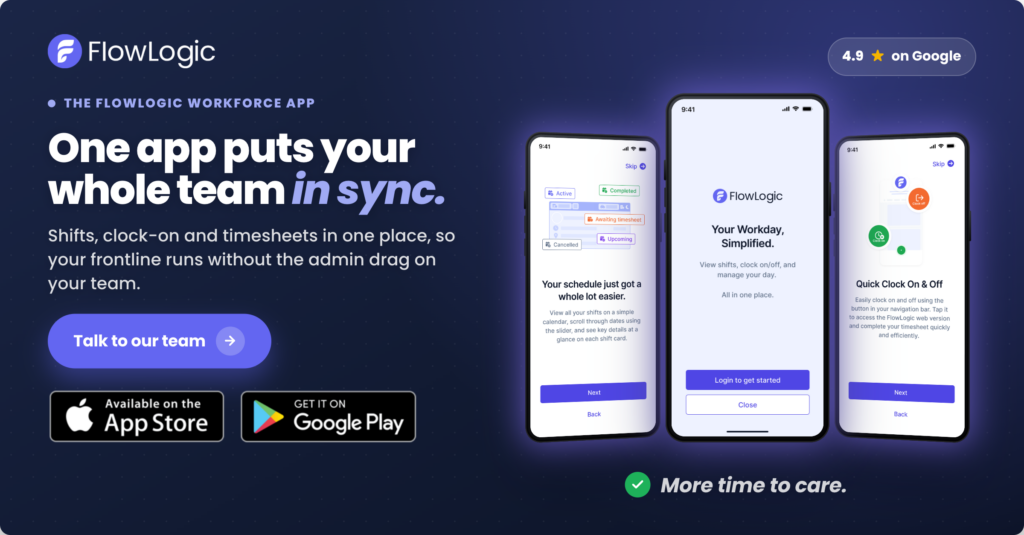
FlowLogic addresses these triggers by unifying scheduling, workforce compliance, incident visibility, and executive oversight into a single, reliable system, helping teams reduce risk, regain control, and refocus on delivering safe, high-quality support.
Operational and Compliance Risks of Legacy Care Platforms

Outdated NDIS platforms don’t just slow down the care team workflow. They can end up exposing organisations to real risk.
Workforce compliance gaps
In aged care and disability services, workforce compliance is a major audit focus. Legacy systems often lack:
- Real-time qualification checks
- Alerts for expiring clearances or training
- Controls that prevent unqualified staff from being rostered
This creates risk before a shift even begins.
Limited audit readiness
When data is spread across multiple systems, preparing for audits becomes reactive and stressful. Without clear audit trails showing:
- Who worked
- When they worked
- Under what qualifications
- Providers struggle to demonstrate compliance with confidence.
Inefficient operations and rising costs
Manual processes increase administrative overhead and make scaling difficult. As organisations grow, these inefficiencies multiply and divert resources away from service quality and workforce support.
Future-ready providers address these risks by modernising around integrated care platform solutions, not isolated tools.
Laying the Groundwork for Care Platform Modernisation
Successful modernisation isn’t about replacing software for the sake of it. It’s about improving how patient care is delivered, managed, and governed.
Assess your current operating environment
Start by understanding how work actually happens today:
- How are rosters built and maintained?
- How do you track qualifications, availability, and compliance?
- Where do delays, errors, or rework occur?
Involve leaders:
- Operations managers
- Rostering and scheduling team members
- Frontline workers
- Compliance managers
- Financial managers
- IT and system managers
This ensures your future platform solves real problems, not just technical ones.
Align stakeholders around care delivery outcomes
Care models touch many parts of the organisation. Alignment is essential.
Modernisation should support:
- Safer workforce allocation
- Better visibility for managers and executives
- Simpler experiences for frontline staff
- Stronger compliance and governance
When teams understand why change is happening (and how it improves daily work), adoption increases dramatically.
Prioritise use cases with measurable impact
Rather than trying to modernise everything at once, focus on high-impact areas such as:
- Workforce scheduling and availability
- Qualification and compliance tracking
- Shift coverage and service continuity
- Reporting for audits and governance
Clear outcomes include:
- Reduced roster errors
- Fewer unfilled shifts
- Improved compliance visibility
- Faster audit preparation
This is where FlowLogic’s care platform solutions deliver immediate value.
Choosing the Right Care Platform Architecture
Technology choices made today determine how adaptable your organisation will be tomorrow.
Platform-based, not point solutions
Many providers struggle because they rely on multiple tools that only solve single problems. A platform approach connects workforce management, scheduling, compliance, and reporting into one system.
FlowLogic is designed as a care platform, not a standalone rostering tool. It’s designed to support growth, change, and integration over time.
Modular and scalable by design
Future-proof care platforms should:
- Scale as your organisation grows
- Adapt to new service types
- Integrate with payroll, finance, and clinical systems
A modular approach allows you to evolve without disruptive system replacements every few years.
Built for interoperability and visibility
Your care platform should support:
- Clean data flows between systems
- Clear audit trails
- Real-time dashboards for operational oversight
This prevents data silos and supports coordinated, compliant care delivery.
Enabling Smarter, Connected Care Workflows

Modern care delivery depends on clear information, smart automation, and secure access.
Automation that supports people
FlowLogic automates high-risk, high-volume tasks such as:
- Qualification-based rostering technology
- Availability matching
- Compliance alerts
This reduces administrative burden while maintaining human oversight where it matters most.
Mobile-enabled workforce coordination
Frontline workers need simple tools to:
- View and manage shifts
- Update availability
- Stay connected to schedules in real time
Mobile-first access improves engagement and reduces last-minute disruptions.
Data Security and compliance by design
Care platforms must protect sensitive personal data while remaining accessible for audits.
FlowLogic embeds:
- Role-based access controls
- Secure data storage
- Detailed audit logs
This ensures compliance is built into daily operations and not added later.
Rolling Out a Future-Proof Care Platform

How you implement a digital care management platform is just as important as the technology itself.
Phased implementation reduces risk
Rather than a disruptive “big bang” rollout, successful providers adopt phased implementation:
- Core workforce and rostering foundations
- Compliance and reporting visibility
- Optimisation and workflow refinement
This approach allows teams to adapt while maintaining service continuity.
Training and change management matter
Adoption depends on confidence. Effective implementation includes:
- Practical, role-based training
- Support during early use with ongoing local, reliable support
When staff feel supported, platforms become enablers.
Measure success through outcomes
Track indicators such as:
- Shift fill rates
- Roster accuracy
- Compliance gaps identified early
- Time saved in scheduling and reporting
- Staff satisfaction with systems
Continuous feedback ensures your care pathways continue to evolve with your organisation.
Conclusion
Care providers don’t need more systems; they need better, supporting platforms.
Legacy tools, disconnected processes, and manual workarounds create unnecessary risk in workforce management, compliance, and service delivery. Modern care platform solutions like FlowLogic address these challenges by being audit-ready 365 days of the year. Ensuring your organisation is embedding visibility, control, and flexibility into everyday operations.
The organisations that modernise now position themselves for:
- Safer, more compliant patient outcomes
- More resilient workforce management
- Scalable growth
- Reduced operational stress
Ready to modernise your care platform?
Contact FlowLogic today for professional care platform solutions and expert guidance tailored to aged care, disability, and community care providers.
Your technology should support great care, not stand in the way.